Imagine opening your crypto wallet one morning and discovering that your $10,000 Bitcoin investment has grown into six or even seven figures. Sounds like a fantasy? For some early Bitcoin investors, that fantasy became reality. Bitcoin has gone from an obscure digital currency worth just a few cents to one of the world's most valuable financial assets. Along the way, it has created millionaires, survived dramatic market crashes, attracted institutional investors, and sparked debates about whether it could become the digital equivalent of gold. Naturally, one question keeps popping up: What will a $10,000 investment in Bitcoin be worth in 10 years? The honest answer is that no one knows. Bitcoin's future price depends on adoption, regulation, market demand, technological developments, and countless other factors. However, history gives us valuable clues, and by combining historical performance with realistic growth scenarios,...
Imagine opening your crypto wallet one morning and discovering that your $10,000 Bitcoin investment has grown into six or even seven figures. Sounds like a fantasy? For some early Bitcoin investors, that fantasy became reality.
Bitcoin has gone from an obscure digital currency worth just a few cents to one of the world's most valuable financial assets. Along the way, it has created millionaires, survived dramatic market crashes, attracted institutional investors, and sparked debates about whether it could become the digital equivalent of gold.
Naturally, one question keeps popping up: What will a $10,000 investment in Bitcoin be worth in 10 years?
The honest answer is that no one knows. Bitcoin's future price depends on adoption, regulation, market demand, technological developments, and countless other factors. However, history gives us valuable clues, and by combining historical performance with realistic growth scenarios, we can build a clearer picture of what may lie ahead.
In this guide, we'll explore:
- What would have happened if you invested $10,000 in Bitcoin a decade ago
- What could happen if you invest today
- The factors that may influence Bitcoin's future value
- Realistic growth projections over 10, 15, 20, and 25 years
- Whether Bitcoin still deserves a place in a long-term investment portfolio
Let's begin by looking backward before we look forward.
A Look Back: If You Had Invested $10,000 in Bitcoin 10 Years Ago
There's a reason Bitcoin is often called one of the greatest-performing assets of the modern era.
A decade ago, many investors viewed Bitcoin as an experiment. Banks were skeptical, governments were uncertain, and most people had never even heard of cryptocurrency.
Those who invested early and held through the market's ups and downs witnessed extraordinary growth.
While Bitcoin's price has experienced multiple corrections of more than 70%, its long-term trajectory has remained remarkably strong compared to traditional investments such as stocks, gold, or real estate.
A $10,000 investment made approximately ten years ago would have appreciated dramatically, even after accounting for Bitcoin's periodic crashes.
The biggest lesson isn't simply that Bitcoin increased in value. It's that time in the market that mattered far more than timing the market.
Investors who resisted the temptation to sell during downturns often saw the strongest long-term gains.
Why Bitcoin Has Grown So Rapidly
Bitcoin's impressive rise isn't based on hype alone. Several key factors have driven demand over the years.
Limited Supply
Unlike traditional currencies that governments can print indefinitely, Bitcoin has a maximum supply of 21 million coins.
Scarcity naturally increases value when demand continues to rise.
Institutional Adoption
Over the past several years, Bitcoin has evolved from a niche investment into an asset held by:
- Public companies
- Asset managers
- Pension funds
- Hedge funds
- Exchange-traded funds (ETFs)
Institutional participation has increased both liquidity and investor confidence.
Growing Global Acceptance
Today, Bitcoin can be:
- Bought through regulated exchanges
- Used by payment platforms
- Held in retirement accounts in some regions
- Accepted by a growing number of businesses
Each new use case expands Bitcoin's long-term potential.
Bitcoin Halving Events
Approximately every four years, Bitcoin undergoes an event known as the halving.
During a halving, the reward paid to miners is reduced by half, slowing the creation of new Bitcoin.
Historically, these events have been followed by periods of increased price appreciation, although past performance does not guarantee future results.
What Makes Bitcoin Different From Traditional Investments?
Unlike stocks, Bitcoin doesn't generate earnings.
Unlike bonds, it doesn't pay interest.
Unlike real estate, it doesn't produce rental income.
Instead, it derives its value from:
| Factor |
Bitcoin |
Stocks |
Gold |
| Fixed Supply |
✅ Yes |
❌ No |
❌ No |
| Generates Income |
❌ No |
✅ Yes |
❌ No |
| Decentralized |
✅ Yes |
❌ No |
❌ No |
| Global Accessibility |
✅ Yes |
Limited |
Limited |
| Trades 24/7 |
✅ Yes |
❌ No |
❌ No |
This unique combination makes Bitcoin unlike any traditional investment class.
What Could a $10,000 Bitcoin Investment Become?
Since nobody can predict Bitcoin's future price with certainty, financial professionals often use compound annual growth scenarios rather than price predictions.
Instead of asking: "Will Bitcoin reach $1 million?"
A better question is: "What happens if Bitcoin grows at different annual rates over the next decade?"
Here's what a $10,000 investment could become under different hypothetical annual returns.
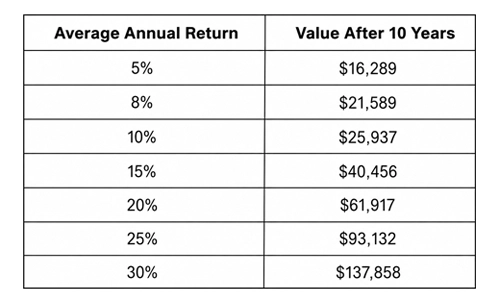
Important: These figures are illustrative examples based on compound growth. They are not predictions of Bitcoin's future performance.
The table highlights one of the most powerful concepts in investing: compounding.
Even modest annual returns can significantly increase wealth when investments are held for long periods.
Why Long-Term Investors Often Ignore Short-Term Volatility
Bitcoin is famous for its price swings.
It's not unusual for the cryptocurrency to gain or lose double-digit percentages within days or weeks.
For new investors, this volatility can feel intimidating.
Long-term investors, however, often view volatility differently.
Instead of reacting to every market movement, they focus on broader trends such as:
- Increasing adoption
- Technological innovation
- Institutional demand
- Supply constraints
- Long-term portfolio growth
History has shown that Bitcoin's largest gains have often followed periods of significant declines.
That doesn't eliminate risk, but it reinforces why patience has historically rewarded long-term holders more than frequent traders.
What Will a $10,000 Investment in Bitcoin Be Worth Beyond 10 Years?
If there's one lesson history has taught investors, it's that time can be one of the most powerful wealth-building tools.
While nobody can accurately predict Bitcoin's future price, we can model different growth scenarios using compound annual returns. This approach is commonly used by financial planners because it focuses on the power of consistent growth rather than making speculative price predictions.
The table below shows what a $10,000 investment could potentially grow to under different annual return rates.
Note: These are hypothetical examples based on compound annual growth and are not forecasts of Bitcoin's future performance.
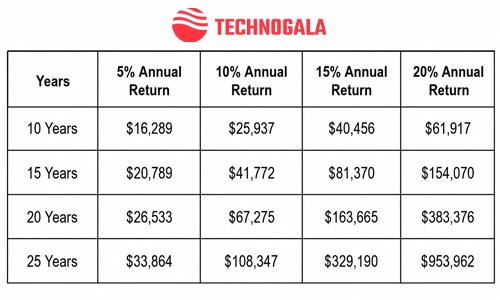
The numbers illustrate a simple but powerful investing principle:
The longer an investment compounds, the greater the impact of each additional year.
This is why many long-term Bitcoin investors aren't focused on tomorrow's price. They're thinking about where the asset could be a decade or more from now.
What Could Influence Bitcoin's Price Over the Next 10 Years?
1. Institutional Adoption
Bitcoin has already attracted interest from:
- Investment firms
- Public companies
- Hedge funds
- Banks
- Bitcoin ETFs
If more institutions continue adding Bitcoin to their portfolios, demand could increase significantly.
Institutional investment also tends to improve market liquidity and strengthen investor confidence.
2. Government Regulation
Regulation can either help or hurt Bitcoin's growth.
Clear regulations often encourage adoption because businesses and investors gain certainty.
On the other hand, restrictive policies could reduce demand in certain markets.
Most analysts believe balanced regulation may benefit Bitcoin by making it more accessible to mainstream investors.
3. Bitcoin Halving Events
Every four years, Bitcoin experiences a halving, which reduces the number of new Bitcoins entering circulation.
Since supply grows more slowly after each halving, increased demand has historically contributed to higher prices over the long term.
Although history doesn't guarantee future results, halvings remain one of Bitcoin's most closely watched events.
4. Mainstream Adoption
The more useful Bitcoin becomes, the more valuable it may become.
Examples include:
- Businesses accepting Bitcoin payments
- Banks offering crypto services
- Cross-border transactions
- Digital asset integration into financial apps
Greater utility often translates into greater demand.
5. Global Economic Conditions
Bitcoin is increasingly viewed as a potential hedge during periods of:
- Inflation
- Currency depreciation
- Banking instability
- Geopolitical uncertainty
Economic conditions could influence whether investors seek Bitcoin as an alternative store of value.
Should You Invest $10,000 All at Once?
Many beginners wonder whether they should invest a lump sum or spread their investment over time.
There isn't a single right answer.
Lump-Sum Investing
Pros
- Money starts compounding immediately.
- Historically performs well in rising markets.
- Simpler to manage.
Cons
- Higher short-term risk.
- Poor timing could mean buying near a market peak.
Dollar-Cost Averaging (DCA)
Dollar-cost averaging means investing smaller amounts at regular intervals instead of investing everything at once.
For example:
Instead of investing $10,000 today, you might invest:
- $500 every month
- $250 every two weeks
This strategy helps reduce the impact of short-term price volatility.
Many long-term Bitcoin investors prefer DCA because it removes emotion from investing.
Bitcoin vs Traditional Investments
Bitcoin is often compared with more traditional asset classes.
Here's how they differ.
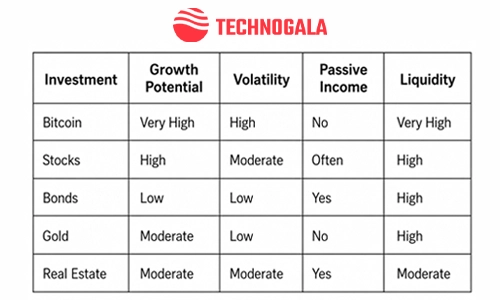
No single investment is perfect.
Many financial experts recommend diversification rather than putting every dollar into one asset.
The Biggest Risks Every Investor Should Know
Bitcoin's upside is exciting, but ignoring the risks would paint an incomplete picture.
Extreme Volatility
Bitcoin has experienced multiple price declines exceeding 70%.
Investors should be emotionally prepared for significant market swings.
Regulatory Changes
Government policies can affect how Bitcoin is bought, sold, taxed, or held.
Regulatory developments remain one of the biggest uncertainties.
Cybersecurity
Unlike traditional bank accounts, cryptocurrency requires users to protect their own wallets and private keys.
Poor security practices can lead to permanent losses.
Market Sentiment
Bitcoin prices often react strongly to:
- Breaking news
- Economic events
- Institutional buying
- Social media trends
Short-term sentiment can create dramatic price fluctuations.
Is Bitcoin Still Worth Investing In?
There isn't a universal answer.
Bitcoin isn't suitable for every investor.
However, many people continue investing because they believe:
- Digital assets will become more widely adopted.
- Bitcoin's fixed supply creates long-term scarcity.
- Institutional demand will continue growing.
- Blockchain technology will play a larger role in global finance.
Others remain cautious because of its volatility and uncertain regulatory environment.
Ultimately, the decision depends on your:
- Financial goals
- Risk tolerance
- Investment timeline
- Overall portfolio strategy
One thing is certain:
Bitcoin has repeatedly demonstrated that it can surprise both its supporters and its critics.
Frequently Asked Questions
1. What will a $10,000 investment in Bitcoin be worth in 10 years?
No one can accurately predict Bitcoin's future value. However, if Bitcoin were to grow at an average annual rate of 10%, a $10,000 investment could grow to approximately $25,937 over 10 years. Higher or lower returns would significantly change the outcome.
2. How much would $10,000 invested in Bitcoin 10 years ago be worth today?
A $10,000 investment made around a decade ago would have appreciated dramatically due to Bitcoin's extraordinary long-term growth. The exact value depends on the purchase date and Bitcoin's market price at that time, but early investors generally experienced returns that far exceeded those of traditional asset classes.
3. Is Bitcoin still a good long-term investment?
Bitcoin remains one of the most widely held cryptocurrencies and continues to attract institutional and retail investors. While it offers significant growth potential, it also carries considerable risk due to price volatility and regulatory uncertainty. Always invest according to your financial goals and risk tolerance.
4. Is Bitcoin safer than investing in stocks?
Not necessarily.
Stocks represent ownership in companies that generate revenue and profits, while Bitcoin is a digital asset whose value depends primarily on market demand. Bitcoin is generally considered more volatile than diversified stock investments.
5. Can Bitcoin reach $1 million?
Some analysts believe it's possible over the long term, while others think it's unlikely. No one can predict Bitcoin's future price with certainty. Investors should avoid making decisions based solely on optimistic price targets.
6. What affects Bitcoin's price the most?
Several factors influence Bitcoin's value, including:
- Supply and demand
- Bitcoin halving events
- Institutional adoption
- Government regulations
- Global economic conditions
- Investor sentiment
7. Should beginners invest all $10,000 at once?
Many financial professionals recommend Dollar-Cost Averaging (DCA) for beginners. Investing smaller amounts over time can reduce the impact of short-term market volatility.
8. What is Dollar-Cost Averaging?
Dollar-Cost Averaging is an investment strategy where you invest a fixed amount at regular intervals instead of making one large investment. It helps reduce the emotional impact of market fluctuations and averages your purchase price over time.
9. Can I lose money investing in Bitcoin?
Yes.
Bitcoin's price is highly volatile, and there is no guarantee that its value will increase. Investors should only invest money they can afford to leave invested for the long term.
10. Should Bitcoin be my only investment?
Most financial experts recommend diversification. Holding a mix of assets such as stocks, bonds, ETFs, and cryptocurrencies can help reduce overall investment risk.
11. Is Bitcoin better for short-term or long-term investing?
Historically, Bitcoin has rewarded many long-term investors who held through market cycles. Short-term trading can be profitable, but it also involves significantly higher risk and requires experience.
12. What is the biggest risk of investing in Bitcoin?
The biggest risks include:
- Extreme price volatility
- Regulatory changes
- Cybersecurity threats
- Market speculation
- Emotional decision-making during bull and bear markets
Understanding these risks is essential before investing.
If you only remember a few things from this guide, make them these:
- A $10,000 investment in Bitcoin has historically produced exceptional long-term returns, though past performance doesn't guarantee future results.
- No one can accurately predict what Bitcoin will be worth in 10, 15, or 20 years.
- Compound growth demonstrates how even modest annual returns can significantly increase wealth over time.
- Bitcoin remains one of the most volatile investment assets, making long-term planning and disciplined investing especially important.
- Diversification and risk management are just as important as chasing high returns.
Should You Invest $10,000 in Bitcoin Today?
The answer depends on your personal financial goals.
If you're looking for guaranteed returns, Bitcoin probably isn't the right investment.
However, if you're comfortable with volatility and believe in the long-term potential of blockchain technology and digital assets, Bitcoin may deserve a place within a diversified portfolio.
Instead of asking: "Will Bitcoin make me rich?"
A better question is: "Does Bitcoin fit into my long-term investment strategy?"
That shift in perspective often leads to better financial decisions.
Whether Bitcoin becomes the world's dominant digital asset or simply one part of a broader investment portfolio, patience, research, and disciplined investing remain the keys to long-term success.
Asking "what will a $10,000 investment in Bitcoin be worth in 10 years?" is exciting, but the truth is that nobody has a crystal ball.
History shows that Bitcoin has transformed modest investments into extraordinary gains for some early adopters. At the same time, it has also tested investors with dramatic price swings and periods of uncertainty.
The future of Bitcoin will be shaped by technological innovation, global adoption, regulation, and investor confidence. While no outcome is guaranteed, one principle has remained consistent across decades of investing: time in the market often matters more than trying to time the market.
If you choose to invest, do so thoughtfully, diversify your portfolio, and invest only what you can afford to leave untouched for the long haul.



How to Use Voice Typing on Your Phone: A Complete Guide
How to Format a USB Drive Easily on Any Device Today
How OTA Updates Keep Connected Devices Secure and Smart
WhatsApp Username: How to Reserve Yours Today Fast