Google is doubling down on OpenAI, and Gemma 4 is its latest move to bring powerful models to everyone, not just cloud giants. Built by Google DeepMind, Gemma 4 is the newest generation in the Gemma family, designed to run across a wide range of hardware, from high-end data centers to everyday smartphones. Unlike massive closed models, Gemma focuses on lightweight, developer-friendly AI that can be deployed locally or customized for specific use cases. What Makes Gemma 4 Different The biggest upgrade with Gemma 4 is flexibility. Instead of a one-size-fits-all model, Google is offering multiple variants optimized for different environments, making it easier to build AI apps without expensive infrastructure. Key highlights include: Models optimized for mobile, edge, and cloud environments Improved performance for reasoning and coding tasks Designed for local execution, reducing reliance on cloud APIs Open ecosystem...
Google is doubling down on OpenAI, and Gemma 4 is its latest move to bring powerful models to everyone, not just cloud giants. Built by Google DeepMind, Gemma 4 is the newest generation in the Gemma family, designed to run across a wide range of hardware, from high-end data centers to everyday smartphones.
Unlike massive closed models, Gemma focuses on lightweight, developer-friendly AI that can be deployed locally or customized for specific use cases.
What Makes Gemma 4 Different
The biggest upgrade with Gemma 4 is flexibility.
Instead of a one-size-fits-all model, Google is offering multiple variants optimized for different environments, making it easier to build AI apps without expensive infrastructure.
Key highlights include:
- Models optimized for mobile, edge, and cloud environments
- Improved performance for reasoning and coding tasks
- Designed for local execution, reducing reliance on cloud APIs
- Open ecosystem encouraging customization and fine-tuning
This approach reflects a growing trend: AI that runs closer to the user, not just in remote servers.
Built on Gemini DNA
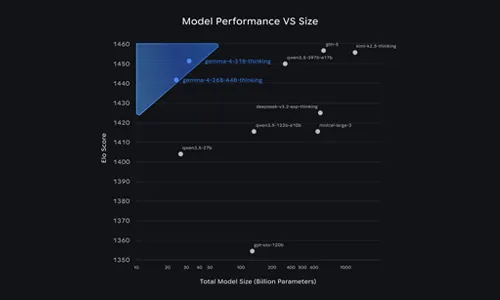
Gemma models are not built from scratch. They are derived from the same research that powers Gemini, Google’s flagship AI system.
That means developers get access to:
- Advanced language understanding
- Multimodal capabilities (text, images, more)
- Strong performance in real-world tasks
Previous versions like Gemma 3 already supported multilingual and multimodal inputs across 140+ languages, and Gemma 4 builds on that foundation with better efficiency and scalability.
Why Developers Are Paying Attention
Since its initial launch, the Gemma family has seen massive adoption, with hundreds of millions of downloads and thousands of community-built variants.
That momentum matters.
With Gemma 4, developers can:
- Run AI models offline on local machines
- Build private AI tools without exposing data
- Customize models for niche applications
- Avoid high API costs tied to proprietary AI systems
In short, it lowers the barrier to building real AI products.
The Bigger Shift: AI for Everyone
The release of Gemma 4 highlights a major shift in the AI industry.
Instead of centralizing power in a few large models, companies are now pushing toward open, portable, and customizable AI systems.
This has huge implications:
- Startups can build faster without heavy infrastructure
- Enterprises can keep sensitive data on-device
- Developers gain more control over how AI behaves
Gemma 4 is not just another model release. It is part of a larger strategy to make AI accessible, flexible, and developer-first. If the trend continues, the future of AI won’t live only in massive data centers. It will run on your laptop, your phone, and maybe even your next app idea. And with Gemma 4, that future is already loading.



Can a Smart Home Work Without Internet? Explained
Solana’s Worth in Future: What Could 1 SOL Be Worth?
How to Wake Up the System From Sleep Mode on Any Computer
The Mokacam 4K Sports and Action Camera: Tiny but Powerful